Galagames burn allowances govern authorized in-game token spending
Galagames lets players authorize in-game token consumption through GalaChain burn allowances. A limited approval sets a token quantity that the authorized game can use, while unlimited approval removes the chosen quantity cap. Granting permission and burning tokens are different events: approval establishes what a game may do, and a supported game action consumes tokens under that permission. The relevant controls concern the selected game and tokens, alongside the available balance and the operation’s other requirements.
The short version: Unlimited burn approval removes the selected token quantity cap while leaving balance, recipient, and action requirements in place.
The token holder, game, and allowance have separate roles
The holder grants permission, the game requests a supported token operation, and GalaChain checks the applicable authorization. The token balance contains the assets available to that holder. An allowance records permission for another party to perform a specified action involving those assets. This relationship lets a game use an authorized amount during play without asking the holder to repeat the original approval for every use while the grant remains usable.
The game determines which action needs tokens and what that action provides. The allowance governs the permission needed to consume them. Owning a token, authorizing its use, and receiving an in-game benefit therefore describe different things. A granted allowance does not establish that every game accepts that token or provides the same benefit.
Burn permission connects gameplay with token consumption
A burn allowance enables a permitted game operation to consume tokens belonging to the holder through GalaChain’s burn mechanism. Burning removes the affected quantity from circulation. The allowance supplies authorization for that operation; it does not itself perform every future burn.
An individual action can consume only part of the approved amount.
A finite grant tracks cumulative authorized consumption
A finite allowance limits cumulative consumption under that grant across its applicable uses. GalaChain records the authorized quantity and the quantity already spent. The remaining quantity of a finite GalaChain allowance equals its authorized quantity minus the quantity already spent under that grant. Earlier consumption therefore reduces the permission available for later requests.
The amount originally granted and the amount still available answer different questions. The original amount describes the permission established at approval. The remaining amount describes how much that particular grant can still authorize. A previous burn can reduce both the token balance and the usable allowance, although those remain separate records with different purposes.
Adding tokens to a balance increases the assets available for consumption. It does not erase the spending already recorded against a finite grant. A replenished balance can therefore coexist with an exhausted grant, even when the interface presents both near the same game.
At protocol level, multiple applicable allowances can contribute to the requested quantity. Before totaling matching quantities, GalaChain excludes expired grants and grants that have exhausted their permitted quantity or uses. One allowance record therefore need not represent the full permission available to the caller. The relevant total includes the usable grants that match the token, authorized recipient, and requested action.
A request that exceeds the usable matching allowance fails the allowance check. That boundary applies to the authorized quantity, independently of whether the wallet holds enough tokens. Raising the permission addresses an authorization shortage. It cannot correct a different token selection, an unavailable balance, or an unmet game requirement.
Unlimited approval changes the quantity boundary
The selected token permission loses its chosen cap
Unlimited approval removes the holder’s chosen quantity ceiling for the selected token permission. A game can continue using that permission without exhausting a deliberately limited quantity. The grant still has an authorized recipient and an action type. Selecting unlimited does not turn a burn allowance into unrestricted permission for every asset or operation.
Continuing permission reaches beyond one purchase
A finite approval creates a reason to revisit authorization when its usable quantity runs out. Unlimited approval removes that interruption, which can suit repeated spending within the same supported game. It also leaves a broader continuing permission over the selected token while the grant remains usable.
The available token balance still constrains consumption. Unlimited permission does not create additional tokens or satisfy the game’s other conditions.
The account flow moves from selection to confirmed permission
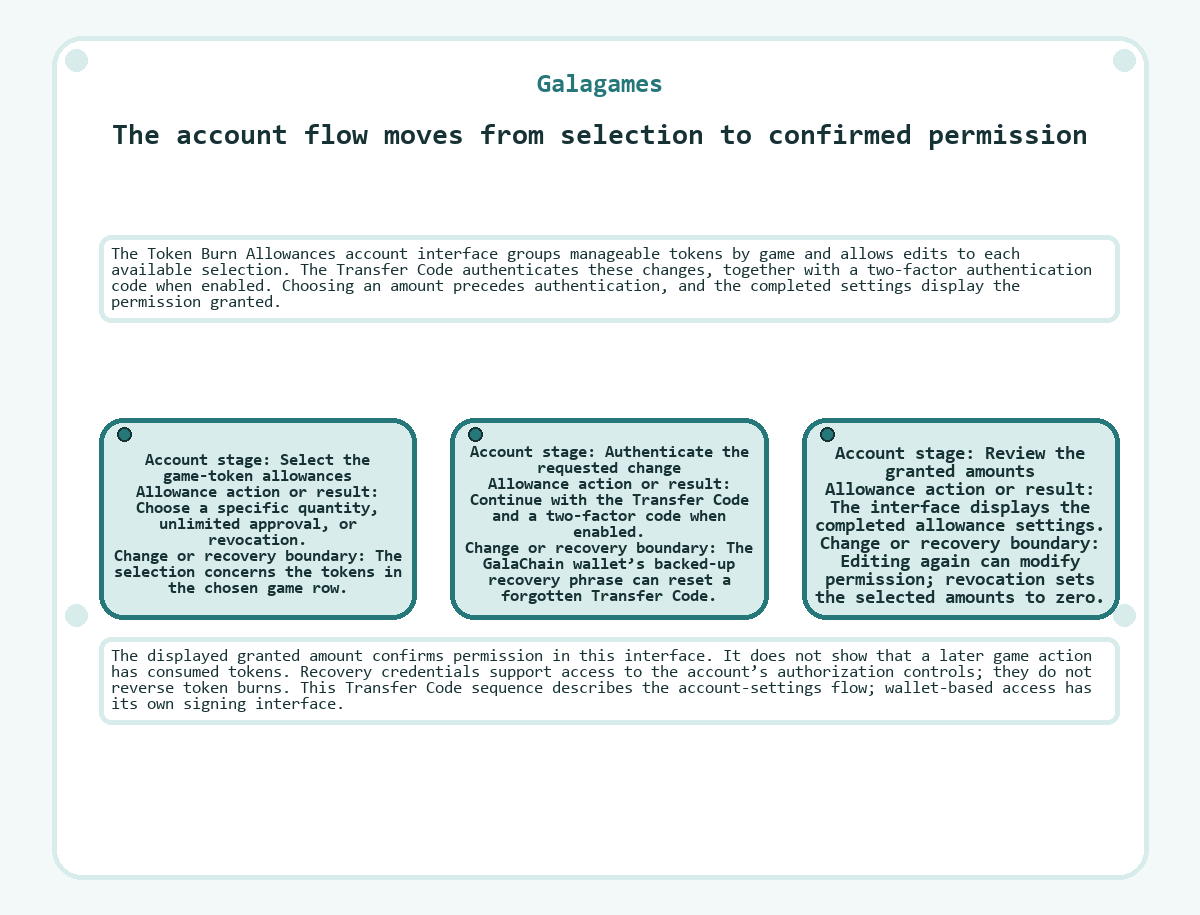
The Token Burn Allowances account interface groups manageable tokens by game and allows edits to each available selection. The Transfer Code authenticates these changes, together with a two-factor authentication code when enabled. Choosing an amount precedes authentication, and the completed settings display the permission granted.
The account flow moves from selection to confirmed permission
The Token Burn Allowances account interface groups manageable tokens by game and allows edits to each available selection. The Transfer Code authenticates these changes, together with a two-factor authentication code when enabled. Choosing an amount precedes authentication, and the completed settings display the permission granted.
- Account stage: Select the game-token allowances Allowance action or result: Choose a specific quantity, unlimited approval, or revocation. Change or recovery boundary: The selection concerns the tokens in the chosen game row.
- Account stage: Authenticate the requested change Allowance action or result: Continue with the Transfer Code and a two-factor code when enabled. Change or recovery boundary: The GalaChain wallet’s backed-up recovery phrase can reset a forgotten Transfer Code.
- Account stage: Review the granted amounts Allowance action or result: The interface displays the completed allowance settings. Change or recovery boundary: Editing again can modify permission; revocation sets the selected amounts to zero.
The displayed granted amount confirms permission in this interface. It does not show that a later game action has consumed tokens. Recovery credentials support access to the account’s authorization controls; they do not reverse token burns. This Transfer Code sequence describes the account-settings flow; wallet-based access has its own signing interface.
| Account stage | Allowance action or result | Change or recovery boundary |
|---|---|---|
| Select the game-token allowances | Choose a specific quantity, unlimited approval, or revocation. | The selection concerns the tokens in the chosen game row. |
| Authenticate the requested change | Continue with the Transfer Code and a two-factor code when enabled. | The GalaChain wallet’s backed-up recovery phrase can reset a forgotten Transfer Code. |
| Review the granted amounts | The interface displays the completed allowance settings. | Editing again can modify permission; revocation sets the selected amounts to zero. |
The displayed granted amount confirms permission in this interface. It does not show that a later game action has consumed tokens. Recovery credentials support access to the account’s authorization controls; they do not reverse token burns. This Transfer Code sequence describes the account-settings flow; wallet-based access has its own signing interface.
Revocation removes permission for subsequent consumption
Revoking the selected game-token burn allowances sets their authorized amounts back to zero. This change removes the remaining permission covered by those settings. It does not refund tokens that a completed action has already burned. Revocation also has a defined scope: changing one game’s selected allowances does not establish the status of unrelated grants.
Available tokens and network fees impose additional constraints
A burn needs sufficient available tokens and any authorization that the requested GalaChain operation requires. An approval can remain generous while the actual balance is insufficient. Conversely, a funded balance can coexist with exhausted permission.
Network fees introduce another cost with a different purpose. GALA pays applicable GalaChain transaction fees, while a supported game action consumes the selected token. When an operation incurs a fee, the account also needs the means to pay it. A token-spending cap does not establish the complete cost of that action.
Fee requirements follow the applicable transaction and channel configuration. The word unlimited describes the grant’s quantity setting and leaves the applicable fee rules unchanged.
The authorized recipient, token identity, and action type define the grant’s reach
The recipient identifies who may use permission
GalaChain allowance checks match the grant’s recipient to the party acting through that permission. A recognizable game name on an account screen represents a particular authorization relationship. Permission granted for one recipient does not automatically establish permission for another. Sharing a blockchain does not make different games interchangeable recipients of the same grant.
The token record identifies the affected asset
Allowance records include token-identifying fields, including collection, category, type, and an additional key. The protocol uses the applicable token identity when matching permission to an operation. A familiar display label alone does not establish that match. The account’s selected game-token entry matters because the authorization concerns the assets identified by that grant.
The action type limits what the grant authorizes
Burn, Use, Lock, and Transfer are distinct GalaChain allowance types. Their names describe different permitted actions, and matching includes the requested type. An allowance that supports an item’s use in a game does not automatically authorize its destruction. The same separation applies when comparing burn permission with permission to transfer a token.
Granted amounts and burn records describe different states
A saved allowance describes authorization, while a burn record describes token consumption associated with an executed burn operation. GalaChain’s allowance-use mechanism writes a claim for each allowance it consumes. Its burn mechanism produces token-burn records. These records concern different aspects of the operation, so an approval confirmation alone cannot establish that spending has completed.
The game’s own rules determine the benefit attached to that spending. A token burn can establish consumption without describing every gameplay consequence. Likewise, a displayed permission amount establishes the allowed scope without confirming item delivery. An authorization problem, a consumption question, and a missing game benefit require different explanations.
Mint allowances and NFT-use permissions serve other purposes
A mint allowance concerns tokens available to mint
A mint allowance represents permission to create the specified tokens for the entitled recipient. Reward-related allowances can appear in account inventory before the corresponding tokens enter a spendable wallet balance. This is a different direction of action from burning tokens already held. A reward allowance and a game’s spending permission can therefore coexist without either one satisfying the other’s purpose.
Node rewards can involve mint allowances. Receiving that entitlement does not authorize a game to consume tokens.
An NFT-use allowance concerns an item’s game use
Games can request permission to use non-fungible tokens, or NFTs, within their supported gameplay. That permission concerns the specified item and action. A burn allowance concerns consumption under a different action type. Similar approval wording can hide this distinction, especially when both requests appear in the same account.
A burn cap controls one permission boundary
A finite cap constrains authorized token consumption through matching burn permissions, while transaction-signature checks govern other authorization boundaries. On 18 August 2026, GalaChain experienced unauthorized transfers involving a signature-scope flaw. The response included a patch binding signature verification to the invoked operation. A game-token quantity cap addresses a narrower boundary than the transaction authorization involved in that incident. Private-key access also carries control over the wallet, beyond a selected game-token spending setting.
Galagames: what people ask
Does granting a burn allowance lock the approved tokens?
A burn allowance does not itself create a token lock. GalaChain treats Burn and Lock as distinct allowance types with different purposes. The burn grant supplies permission to consume eligible tokens; a separate locking mechanism concerns their availability. A game can have additional requirements, so the granted burn amount alone does not establish that every token in the balance is available.
Can Ethereum approval controls revoke my GalaChain game permissions?
Revoking an Ethereum token approval changes the permission on Ethereum, not a separate GalaChain game grant. The two networks maintain different authorization records. GalaChain burn settings concern the selected game-token allowances associated with that account. Using the same wallet identity across networks does not combine those permissions, and a successful Ethereum revocation does not confirm that a GalaChain burn allowance has changed.
When does an unlimited burn allowance expire?
Unlimited describes the quantity setting, while any configured expiration governs how long the grant remains usable. GalaChain allowance records include an expiry field, and allowance checks exclude expired grants. Removing the chosen token quantity cap does not establish a universal lifetime. A grant’s expiration and a signed request’s validity window also concern different objects.
Will Web3 wallet migration remove my Galagames burn allowances?
Migrating the existing Gala account to Web3 wallet access preserves the allowances associated with that account. The transition announced on October 5, 2026, uses the existing wallet’s private key to retain the same account identity. It is distinct from creating a new wallet or account. That announcement also kept email login available during the transition without setting a retirement date.
How should I interpret a burn allowance when token prices change?
A finite burn allowance limits token quantity, not a fixed cash value. Changes in a token’s market price do not redefine the amount authorized by that grant. The same remaining token permission can represent a different cash value over time. Any applicable transaction fee also remains a separate cost, so the allowance amount alone does not describe the complete expense.